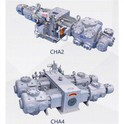
The compression ratio is a fundamental parameter in the operation of a gas reciprocating compressor. It is defined as the ratio of the absolute discharge pressure to the absolute suction pressure of the compressor. In the context of our business as a supplier of Gas Reciprocating Compressor, understanding how the compression ratio affects the performance of these compressors is crucial for both us and our customers.
Impact on Efficiency
One of the most significant ways the compression ratio affects the performance of a gas reciprocating compressor is in terms of efficiency. Generally, as the compression ratio increases, the efficiency of the compressor tends to decrease. This is mainly due to the increase in the work required to compress the gas.
When the compression ratio is low, the pressure difference between the suction and discharge sides is relatively small. As a result, the compressor can operate more smoothly, and less energy is wasted in overcoming the pressure resistance. For example, in a low - compression - ratio application where the suction pressure is around 100 kPa and the discharge pressure is around 200 kPa, the compressor can transfer gas with relatively less effort. The mechanical losses are minimized, and the overall efficiency can be quite high.
However, when the compression ratio is high, say from 100 kPa suction pressure to 1000 kPa discharge pressure, the compressor has to work much harder. The gas has to be compressed to a much higher pressure, which requires more energy input. Moreover, the increase in temperature during the compression process becomes more significant at higher compression ratios. This increased temperature can lead to increased friction in the moving parts of the compressor, further reducing efficiency. The compression work done by the compressor is given by the formula (W = \frac{n}{n - 1}P_1V_1\left[\left(\frac{P_2}{P_1}\right)^{\frac{n - 1}{n}}-1\right]), where (P_1) and (P_2) are the suction and discharge pressures respectively, (V_1) is the suction volume, and (n) is the polytropic exponent. As the ratio (\frac{P_2}{P_1}) (compression ratio) increases, the value of (W) increases, indicating more work is required.
Effect on Capacity
The compression ratio also has a direct impact on the capacity of the gas reciprocating compressor. Capacity refers to the volume of gas that the compressor can handle per unit time. As the compression ratio increases, the volumetric efficiency of the compressor decreases, which in turn reduces the capacity.
At low compression ratios, the gas is compressed less severely, and the volumetric efficiency is relatively high. The compressor can draw in and compress a larger volume of gas. For instance, in a compressor with a low compression ratio, the clearance volume (the volume of gas that remains in the cylinder after the discharge stroke) has a relatively small impact on the overall performance. The fresh gas can easily enter the cylinder during the suction stroke, and the compressor can operate at a high capacity.
However, at high compression ratios, the situation is different. The high - pressure gas in the clearance volume expands more during the suction stroke, taking up more space in the cylinder. This reduces the amount of fresh gas that can enter the cylinder, thus decreasing the volumetric efficiency. For example, if the compression ratio is very high, the expanded gas from the clearance volume may fill a large portion of the cylinder, leaving less space for the new gas to be drawn in. This results in a lower capacity of the compressor.
Influence on Temperature Rise
Temperature rise is another important aspect affected by the compression ratio. During the compression process, the gas is compressed, and its internal energy increases, leading to a rise in temperature. The higher the compression ratio, the greater the temperature rise.


When the compression ratio is low, the temperature rise is relatively small. This is beneficial for the compressor because it reduces the thermal stress on the components. For example, in a low - compression - ratio application, the compressor valves and pistons are not subjected to extremely high temperatures, which can extend their service life.
In contrast, at high compression ratios, the temperature rise can be substantial. High temperatures can cause several problems. Firstly, it can lead to the degradation of the lubricating oil used in the compressor. The oil may lose its viscosity and lubricating properties, resulting in increased wear and tear of the moving parts. Secondly, the high temperature can also cause thermal expansion of the compressor components, which may lead to dimensional changes and affect the proper functioning of the compressor. For example, if the piston expands too much due to high temperatures, it may cause a tight fit in the cylinder, increasing friction and potentially leading to mechanical failures.
Impact on Mechanical Stress
The compression ratio also affects the mechanical stress on the compressor components. As the compression ratio increases, the forces acting on the pistons, connecting rods, and crankshafts also increase.
At low compression ratios, the forces are relatively small. The pistons move more smoothly, and the connecting rods and crankshafts are not subjected to excessive loads. This reduces the risk of mechanical failures and extends the service life of the components. For example, in a low - compression - ratio compressor, the piston rings experience less wear because the pressure difference across them is small.
However, at high compression ratios, the mechanical stress on these components can be extremely high. The pistons have to withstand much higher pressures, which can lead to increased wear on the piston rings and the cylinder walls. The connecting rods and crankshafts are also subjected to larger forces, which can cause fatigue and eventually lead to failures. To withstand these high forces, the components need to be made of stronger materials, which can increase the cost of the compressor.
Practical Considerations for Our Business
As a supplier of Gas Reciprocating Compressor, we need to take these factors into account when providing solutions to our customers. Different applications require different compression ratios. For example, in some natural gas gathering systems, a relatively low - compression - ratio compressor may be sufficient to transfer the gas from the wellhead to the processing plant. On the other hand, in applications such as gas injection for enhanced oil recovery, a high - compression - ratio compressor may be required.
We also need to educate our customers about the trade - offs associated with different compression ratios. For instance, a customer may want a high - compression - ratio compressor to achieve a higher discharge pressure, but they need to be aware of the potential decrease in efficiency, capacity, and the increase in mechanical stress and temperature rise.
In addition, we offer Movable Supercharged Gas Production and Water - drained Gas Recovery Unit which can be designed with appropriate compression ratios according to the specific requirements of the application. These units are flexible and can be used in different locations to meet the needs of gas production and recovery.
Conclusion
In conclusion, the compression ratio has a profound impact on the performance of a gas reciprocating compressor. It affects the efficiency, capacity, temperature rise, and mechanical stress of the compressor. As a supplier, we understand these effects and can provide our customers with the most suitable compressors based on their specific requirements.
If you are in need of a gas reciprocating compressor or have any questions about the compression ratio and its impact on performance, please feel free to contact us. We are ready to have in - depth discussions and provide you with the best solutions for your gas compression needs.
References
- Stoecker, W. F., & Jones, J. W. (1982). Refrigeration and Air Conditioning. McGraw - Hill.
- Karassik, I. J., Messina, W. C., Cooper, P. T., & Heald, C. C. (2008). Pump Handbook. McGraw - Hill.